Blood on the Tracks
In the late 1870s, two ambitious railway companies — Santa Fe Railway and Denver & Rio Grande — vied for control over the vast and untamed Colorado landscape. Their sights were set on expanding into New Mexico, but one formidable obstacle stood in their way: a single path through the treacherous Royal Gorge.
Carved by the relentless forces of the Arkansas River, the Royal Gorge is a breathtaking 10-mile stretch of canyon with towering 1,200-foot walls. Only one railway could lay claim to this narrow passage, and the competition was fierce. In 1878, the Royal Gorge War erupted, with both companies resorting to every tactic imaginable — from sabotage to legal battles, and even hiring notorious gunslingers like Doc Holliday to defend their stakes.
The final showdown came not on the rugged tracks but in a courtroom, where the Treaty of Boston was signed. Denver & Rio Grande emerged victorious, securing the rights to the gorge but at the cost of paying Santa Fe nearly $2 million for their work.
18RoyalGorge transports 2–4 players into the thick of this historic conflict. Manage your rail-road empire, hire gunslingers, deliver precious gold, and outwit your rivals to become the most powerful tycoon in Colorado's railroading history.
But beware… at this table, there are no allies.

Flow of the Game
The game begins with a special round called the Private Asset Auction, during which five private asset cards are auctioned off.
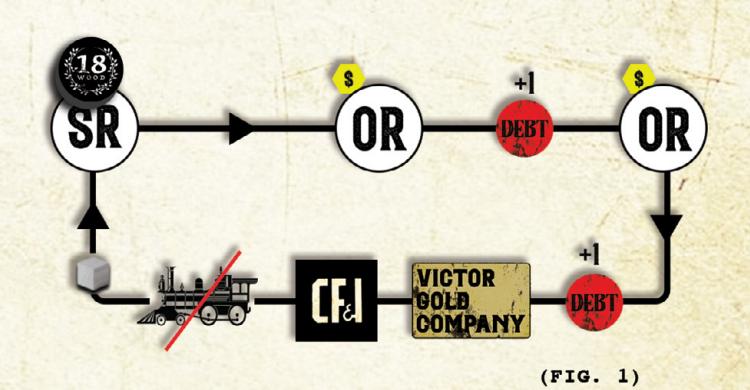
After the initial auction, the game alternates between Stock Rounds (SR) and Operating Rounds (OR). There is always one Stock Round followed by two Operating Rounds. Players use the round tracker disc to track the current round by moving it along the arrows at the conclusion of each round.
At the end of the second Operating Round, end-of-round upkeep occurs, during which dividends for gold and steel are paid, a train is exported from the game, and the steel market is reset with steel cubes.
Players continue this sequence of Stock and Operating Rounds until one of the game-ending conditions is triggered.
Components
Three important notes up front:
- Sticker Sheet: You may notice an extra Colorado Midland sticker on your sheet. This was a printing mistake and is not needed in the game. Please ignore it.
- Brothel Token: The Brothel token is double-sided, which is correct.
- Money Supply: The money cards are unlimited. If you ever run out during play, just substitute coins, poker chips, slips of paper, or whatever works at your table.
General Components
- Game Board, Player Aids, Payout Chart
- 11 Company Charters, Rulebook, Gold Mine Tiles
- Sticker Sheet, $2+ × 50¢ pieces, 100+ Money Cards
- 25 Private Asset Cards (Yellow, Green, Brown backs)
- 30 Train / Event / Phase Cards (numbered backs)
- 99 Company Share Cards, 10 CF&I Shares, 10 Victor Gold Shares
- Wooden components: 7 Debt Markers, company tokens, Brothel Token, Buckhorn Exchange, Ghost Town Tokens, 1 Large Round Marker, 20 Gold Cubes, 20 Coal Cubes, 30 Steel Cubes, 1 Wooden Revolver (first-player marker)
- Punchboard Track Tiles — yellow, green, brown, plus special gorge tiles and a silver tile (#171)
- 5 × "S" tiles (1 Yellow, 2 Green, 2 Brown) · 3 × "R" tiles (1 each)
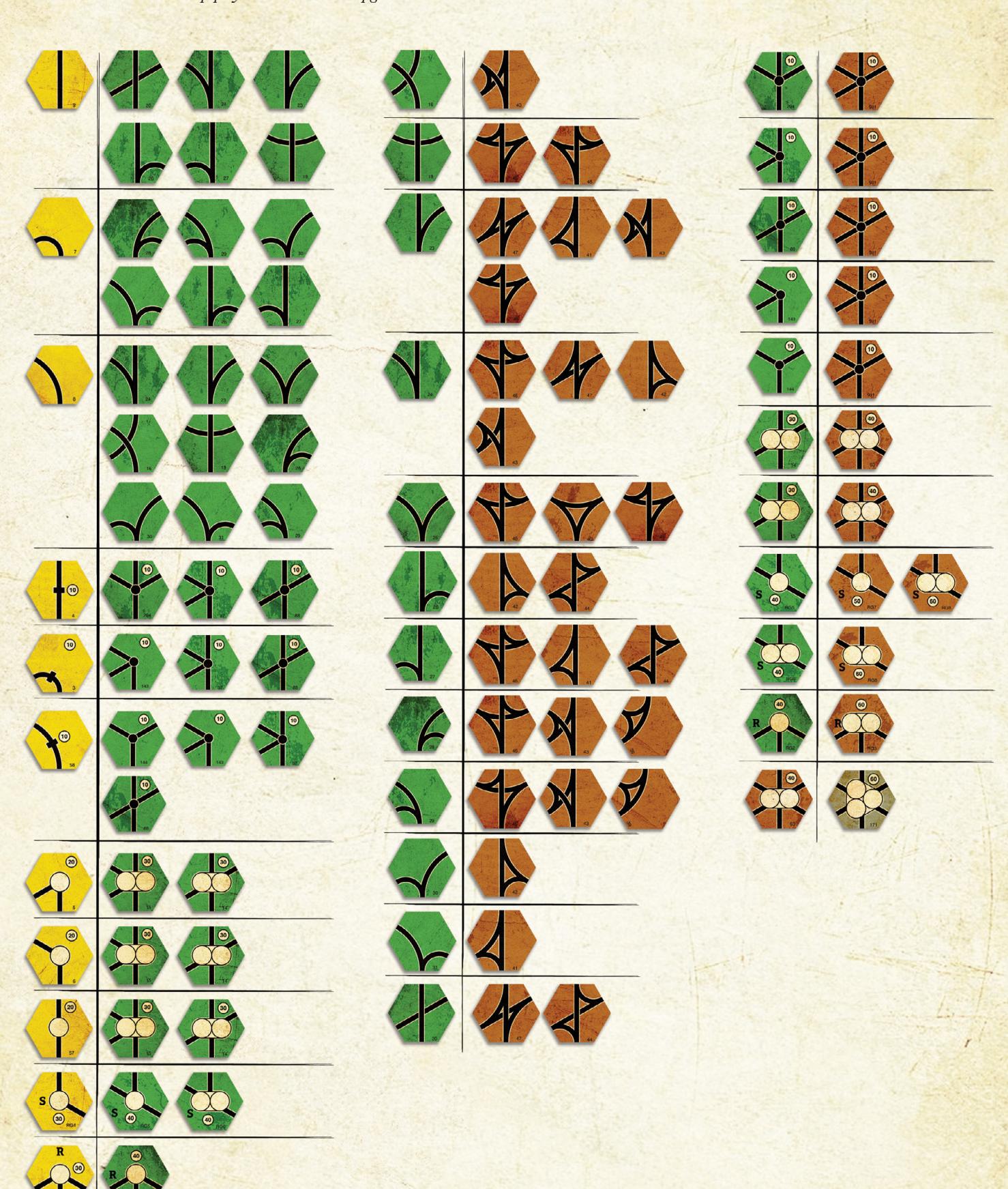
A full component manifest with counts of every track-tile type is in the PDF rulebook.
Setting Up the Game
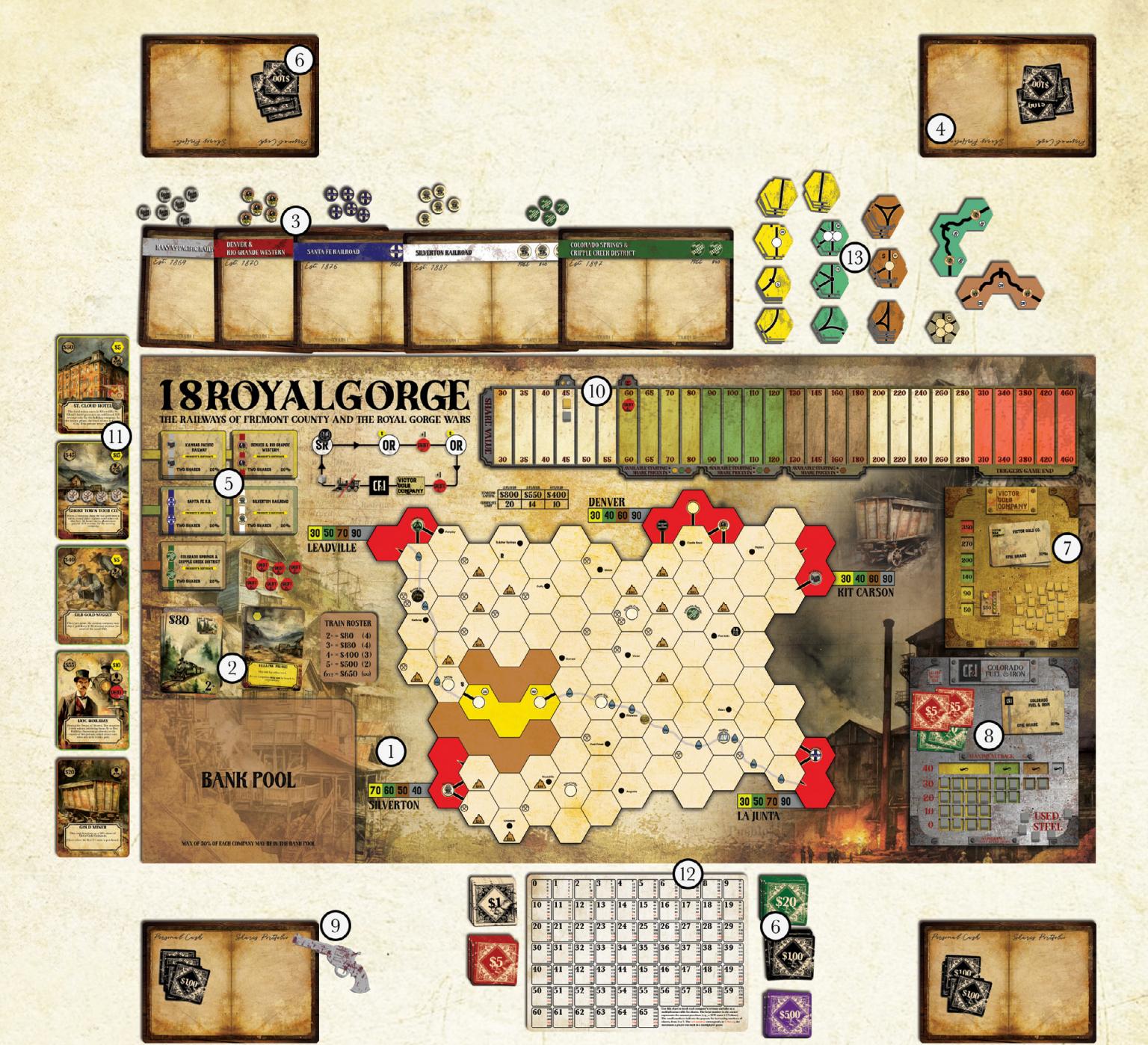
- Place the game board in the middle of the table.
- Sort the train/phase deck by the numbers on the back of the cards (1–25). Once sorted, flip the deck over so that the cards are face up and place them on the designated space. The yellow phase card (#25) should now be face up at the top of the stack. Place it on the matching phase space beside the train deck, revealing the 2+ train.
- Set the Santa Fe and Rio Grande company charters near the board. Then shuffle the remaining charters and select three at random; place these near the board as well. Place the tokens matching the five companies near their respective charters.
- Give each player one of the remaining company charters. Players place these face down in front of them, turning them over to reveal the "Player Cash" side. Unused charters return to the box.
- Locate the shares for the five selected companies. Place the shares of the two earliest-established companies (year below the company name) in the two yellow share boxes (upper-left of the board), President's Share on top of each face-up stack. Place the next two in the green boxes; the final company's shares go in the brown box.
- Form a bank and give each player their starting capital (see chart below).
- Place the Victor Gold Company shares on the board along with all gold cubes.
- Place the CF&I shares on the CF&I plaque. Place one steel cube on each of the yellow, green, and brown spaces in the steel market. Set remaining steel aside. Place $50 on the CF&I plaque as a starting dividend.
- Assign the priority deal marker (Revolver) to the player who most recently "shot someone in cold blood" for attempting to build train tracks through the Royal Gorge. (Failing that, assign it randomly.)
- Place a debt token on "60" on the share value track. Place a gold cube and a steel cube on "45". Place remaining debt tokens near the train/phase deck.
- Shuffle each set of private company cards. Deal two yellow, two green, and one brown, placed in a line (yellow → green → brown). If any privates refer to "coal," place coal cubes near the board.
- Place the revenue chart near the board.
- Separate the track tiles by color and type. Place the yellow gorge tile on the gorge space with the "B" side down. Other gorge tiles also "B"-side down.
- You are ready to play!

| 2 Player | 3 Player | 4 Player | |
|---|---|---|---|
| Starting Capital | $800 | $550 | $400 |
| Certificate Limit | 20 | 14 | 12 |
A Few Important Concepts
Player Money vs. Company Money
Players operate train companies to earn money. Companies pay dividends to shareholders, so the president is not the only one who profits — anyone invested in the company does as well. Keep personal money on your cash mat and company money on the company charter. These two pools must never be used interchangeably unless stated otherwise.
When buying a share, the money comes from the player's assets. When purchasing a train or paying terrain costs, the money comes from the company charter.
Stock Value Movement
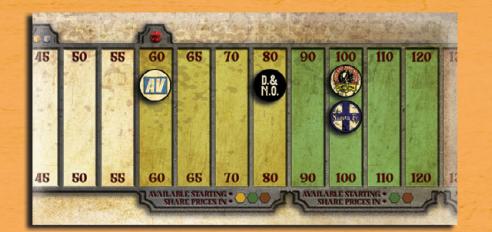
The stock value track (stock market) tracks each company's share price. When moving tokens, place them below existing tokens — including when a company first starts. Stack or arrange tokens in a column to maintain order. After a company operates and increases in value, turn its token face down to show it has completed its turn. After the operating rounds, return tokens to face up while maintaining order.
Phase Changes
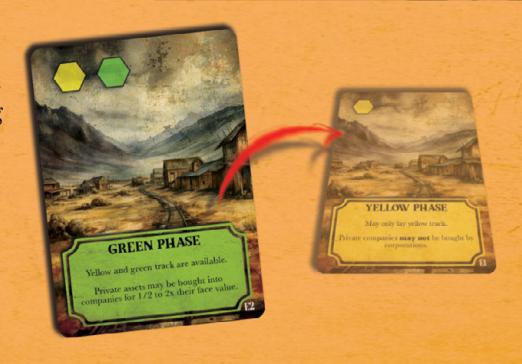
The game begins in the Yellow Phase. Phase changes occur when a phase-change card is revealed during the purchase or export of trains. Once revealed, the phase shifts immediately, with the new card placed on top of the previous phase card.
Phase changes unlock new track tiles, allow more companies to be started, and introduce new strategic options.
Resolving Events
Events are resolved immediately upon being revealed as players purchase trains from the deck.
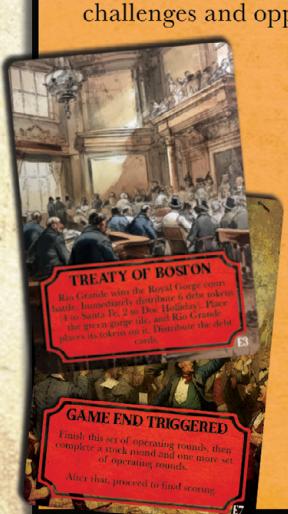
Rio Grande becomes the primary owner of the Royal Gorge and places two additional tokens on the newly placed green gorge tile. Two debt cards are distributed to Santa Fe and Doc Holliday, representing the debt owed. The indebted parties must purchase these debt tokens to settle their obligations.
Older trains are removed from the game as newer technology arrives. The holding company receives a small compensation (salvage).
Triggers the end of the game. Players finish the current set of operating rounds, complete a stock round, then play one final set of operating rounds.
Routes & Revenue Centers
Throughout the game, players lay new track to create Routes for their train companies to operate on. This is the core premise of (almost) all 18xx games: lay track to reach new revenue centers and use your trains to collect revenue, earning money for yourself and other shareholders.
What is a Route?
A route is any length of unobstructed and usable track (not blocked by station tokens from other companies). When a company runs trains on these routes to produce revenue, those routes must include at least two revenue centers.
Ahh… but we've skipped ahead of ourselves again. Let's first talk about what a Revenue Center is.
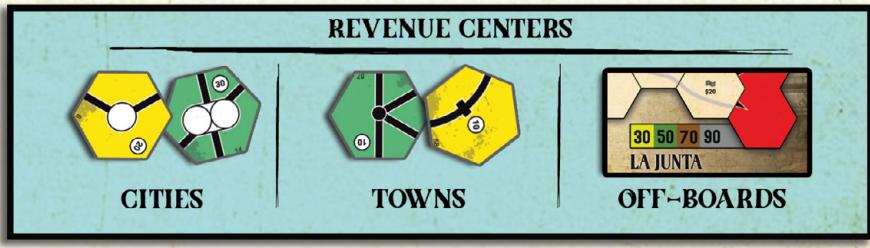
Revenue Centers
Cities
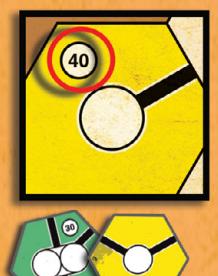
Large white circles. Potential revenue varies but cities can be upgraded. Cities must always be upgraded with tiles that also contain cities.
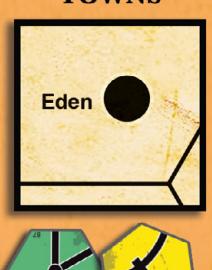
Towns
Black dots — "Towns" in more remote areas with smaller revenue. They do not generate any revenue initially but can be upgraded with tiles that display the town icon (dash or dot).
Off-Boards
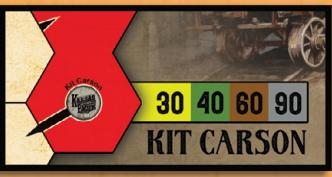
Distant destinations beyond the map (e.g., Kit Carson). These locations are never modified by players but change revenue as phases progress.
Tokens
Some tokens are not revenue centers themselves; instead, they increase the value of existing revenue centers or plain track hexes (such as ghost towns).


Routes for Track-Laying
To lay a new tile, a company must be able to run a route on some portion of the newly placed tile. When placing track, a company does not need to reach any revenue centers — they simply need to trace a route back to one of their stations from the newly placed track, unobstructed by other companies' station tokens or unusable track (e.g., sharp turns).
When determining routes for placing new track, trains are considered "imaginary" and can run an "infinite" length of track — even if the company doesn't have a train that can cover that distance, or doesn't own any trains at all. The only restriction is that the route must not be blocked by station tokens.
It is also not required for the company to use the newly placed track on the turn they place it — in fact, they are never required to use that track at any point in the game.
In Conclusion…
A route is any length of consecutive, unobstructed, and useable (no hairpin turns etc.) track pieces extending from the company's stations.
But… when running trains on these routes to produce revenue, the route must contain a station token, and at least two revenue centers.
Priority Deal

The priority deal marker (revolver) determines which player acts first in each stock round.
- During setup: priority deal is assigned randomly.
- After the initial auction: the player with the most cash on hand receives priority deal.
- At the end of each stock round (including the first), priority deal shifts to the player to the left of the last player who took an action.
Private Asset Auction
The private asset auction allows players to purchase private asset cards, which provide income each round and offer special abilities.
Cards are auctioned left-to-right — the two yellow-backed cards first, then the two green, then the single brown.
Starting with the player holding priority deal and proceeding clockwise, each player may bid. Bids must be in $5 increments and higher than the previous bid. Bids cannot be lower than the "Initial Bid Price" on the card.
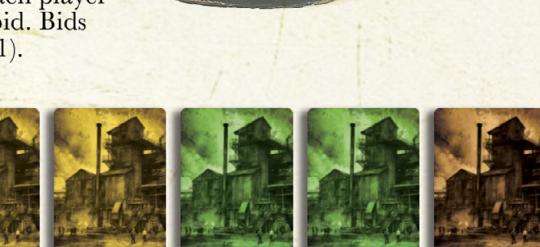
If a player passes on an asset card, they are out of the current auction. If all players pass on an asset card, it is removed from play and the auction restarts with the next card.
Once all but one player has passed, the highest bidder pays the bank and takes the card into their play area. They now personally own the asset; it can sometimes be sold to a company later. The auction winner starts the next auction.
After the final private asset auction, priority deal goes to the player with the most remaining money.
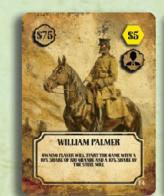

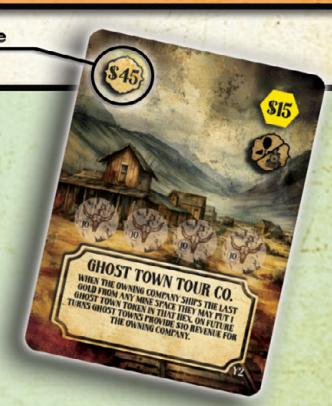
Jim, Derek, and Lesley are locked in a heated auction for the Ghost Town Tour Company. Jim, holding the priority deal card, knows this asset could be a game-changer. He confidently starts the bid at $65, determined to claim it. Derek, with his sights set on the next asset "William Palmer," decides to pass and sits out the rest of the auction.
Lesley isn't particularly interested in the Ghost Town Tour, but she knows Jim is eager. She ups the bid to $75, testing Jim's resolve. She could have gone up by just $5, but she wants to see if Jim will blink. Not one to back down, Jim counters with $80.
Lesley senses that Jim really wants this one, so she raises the stakes to $85, hoping to push him to his limit. Jim, frustrated by the escalating price, reconsiders. Reluctantly, he passes, letting the Ghost Town Tour slip through his fingers.
Victory for Lesley! She hands over $85 to the bank, placing the Ghost Town Tour Company card in front of her. With the first auction behind her, she prepares to start the bidding for the next prize: the coveted William Palmer card.
Stock Round
Stock rounds are key moments where players strategically invest their money, aiming for dividends and growth in value. Starting with the priority deal holder and moving clockwise, each player has the chance to invest in one of the five powerful train companies, CF&I, or the Victor Gold Company.
A stock round concludes when all players have consecutively passed. The priority deal marker then shifts to the left of the last player who made a move, setting the stage for the first operating round.
Selling
Sell shares you own to the bank; place the certificate(s) in the bank pool and receive money from the bank equal to share price × number of shares sold.
- You must perform all sell actions before you buy.
- No more than 50% of a company's shares may be in the bank pool. A sale that would exceed this is not allowed.
- If the president sells shares of their own company, the share price drops one step left per share sold — even if the sale triggers a change in presidency.
Buying
Buy a share from a company's treasury or from the bank pool. This includes CF&I and Victor Gold shares. Purchasing a president's certificate means you are starting that company.
- If you sell a company's stock during a stock round, you cannot repurchase that stock until the following stock round.
- You may not own more than 60% (70% in a two-player game) of any company's stock.
- When buying from the bank pool, pay the current share price to the bank. When buying from the company treasury, pay the current share price into the company's treasury.
Starting a Company
The purchasing player (the incoming president) sets the initial share price by placing the company's share-value token on the stock track. Optional starting prices depend on the current phase:
- Yellow May set price anywhere in the yellow region.
- Green May set price anywhere in the yellow or green regions.
- Brown May set price anywhere in yellow, green, or brown regions.
- Silver Same as brown phase.
The player then pays twice the chosen share price (president's certificate = 2 shares) to the company treasury and takes the president's certificate and charter. The remaining share certificates go on the company charter, and the company's home station is immediately placed in its starting location on the board.
About Presidency
Whichever player owns the most shares in a company is always the president. If another player ever has more shares than the president, that player immediately becomes the new president. The new president exchanges two of their 10% shares for the outgoing president's 20% share and moves the charter (including cash and trains) into their play area.
Presidency changes in two scenarios:
- A player purchases shares in a stock round and now has more shares than the current president.
- The current president sells shares and now owns fewer shares than another player.
A president's certificate cannot be sold to the bank unless another player owns at least 20% of that company. A company must always have a president. The exchange of presidency is always immediate and compulsory — a player cannot refuse it.
Certificate Limits
A certificate is a single card that represents either a 20% share or a 10% share (a president's share is one certificate). Each personally owned private asset card is also considered a certificate. Certificate limits are: 20 (2-player), 14 (3-player), 12 (4-player). No player may own more than 60% of any given company (including CF&I and Victor Gold).
Jim has the priority deal and begins the stock round. He decides to start Rio Grande. Since the game is in the Yellow Phase, he can start the company at $60, $65, $70, or $80 per share. He decides to start high at $80. He puts $160 of his own money on the Rio Grande charter and places it in his play area, placing one of Rio Grande's tokens on the "80" space of the share value track. Jim takes the 20% President's Share and places it on his cash mat. The remaining shares go on Rio Grande's charter. Jim is now president.
Next up is Derek. He bought quite a few privates in the initial auction and only has $110 left. The lowest he can start a company for is $65 per share — a President's Share would cost a minimum of $130, so Derek can't start a company. He decides to invest in Jim's Rio Grande instead, paying $80 to Rio Grande's treasury in exchange for a 10% share from the charter.
Now Kayla. She has plenty of money but isn't interested in the other company currently available to start. She thinks she'll profit more by investing in steel, because Jim's company will definitely be laying track. So she buys a share of CF&I. Since the game just started, this share costs $45. Kayla pays $45 to the bank and takes a 10% share. She's smart to do this — not only will she profit from steel dividends, but it will also make Jim think twice about laying too much track.
It is now Jim's turn again.
End of a Stock Round
The stock round continues until all players have passed. Priority deal then moves to the player to the left of the last person to act.
If a player passes but others act afterward, they may re-enter the stock round — but risk losing priority deal.
If at the end of a SR all shares for a company are held by players, the company's price moves one space to the right (increases). This applies to the gold and steel companies as well.
Operating Rounds
During operating rounds, players step into the driver's seat of the corporations they control. The president of each started company decides where to lay track, build stations, run trains, and buy more trains.
Operating rounds follow turn order based on stock-market position: the highest-priced company operates first. Ties are broken by which company reached that price first (the one positioned higher on the stock market). Each company completes its entire turn before the next begins.
Income (Start of Round)

Private assets pay income to their owners (players or companies) at the start of each operating round. All owners receive money from the bank before the round begins. Note that private assets only pay income during certain phases — check each card's details to confirm when it applies. Since this step is easy to overlook, players should remind each other to ensure everyone receives their income. If someone forgets, they should collect their income as soon as they remember.
The Six (or Seven) Steps of a Company Turn
- Lay Track
- Build a Station
- Run Trains
- Pay or Withhold
- Buy Trains
- Pay Debt (Santa Fe & Rio Grande only)
Possible 7th action: Buying Private Assets (any time during turn) — once Green Phase is triggered.
Know the Importance of Each Action
Laying new track opens up longer routes or connects to richer revenue centers. Always seek out paths that boost the company's profits!
Trains can't reuse any track, no matter how small. New stations let you start from fresh spots on the map!
Running your trains generates the game's most vital resource: money. Hunt down the most profitable route you can!
You're a shareholder too! Keep the money or invest in terrain, stations, and new trains? The choice is yours!
Your current trains have limits, and as technology advances, they might become obsolete. It's time to build bigger, better trains. Lead the industry!
Buying private assets unlocks powerful advantages for your company! Which ones will you choose?
1. Lay Track
Each operating company may lay up to six track tiles per turn, provided they have funds and legal permissions. The type of track available depends on the current phase:
- Yellow Only yellow tiles may be built.
- Green Green and yellow may be built.
- Brown Brown, green, and yellow may be built.
- Silver All track is available.
The 5 Rules of Track-Laying
Yellow can be placed directly on the board. Yellow → Green → Brown → Silver. Towns must be upgraded with track that has a town on it (dash or dot). Cities must be upgraded with track that has a city space on it.
Exception: If a company's home station is on a space with a town, that space must contain a city tile, even if the company has not started yet. This applies to the starting tiles of two companies. If that company is not in the game, the space will remain a town for the entire game. Additionally, some private companies may grant an exception to this rule; in such cases, the rules on the card take precedence.

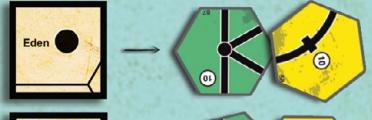
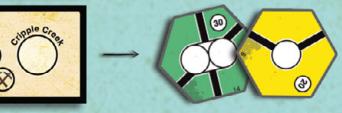
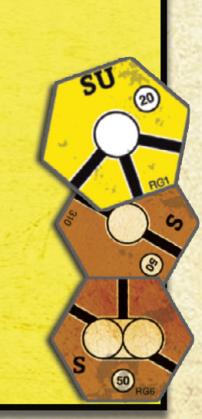
Track may run into the edge of other previously laid tiles, but not off the map edge. Some hexes have special "S" tiles (e.g., Salida) for this purpose. Red off-board areas may only be reached at pre-printed track spots.
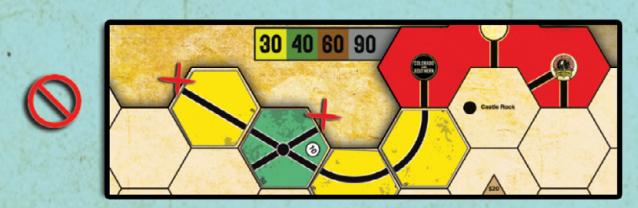
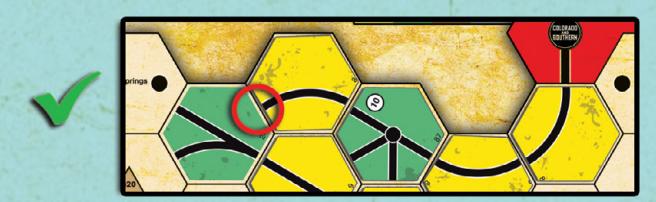
No exceptions. This includes tiny pieces of track.


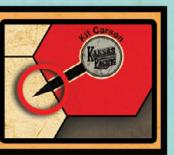
The company doesn't need to use the track now or ever, but it must theoretically be able to run a route on at least one portion of the new segments. Assume the company has an imaginary train of unlimited length.
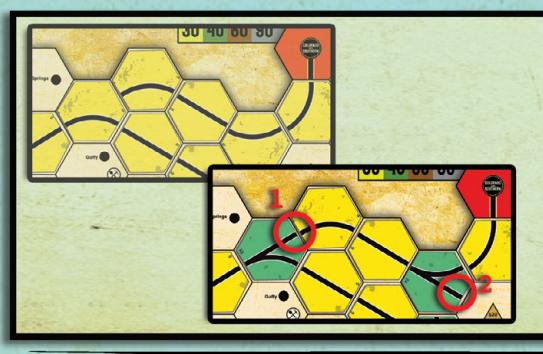
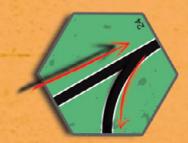
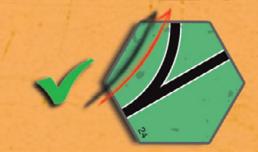
Colorado Southern is running from Denver and wants to upgrade two yellow tiles to the green tiles shown in the diagram.
- Tile 1: C&S added a straight leg to the north — this is a legal tile placement because the train station in Denver can run to that new track.
- Tile 2: C&S added a sharp turn below the straight track — this is not a legal placement, because trains are not allowed to do a sharp turn. (See Running Trains.)
Every newly placed yellow tile, and each upgrade, requires a steel cube purchased from the CF&I steel market.
Buying Steel from CF&I
As steel demand rises, each subsequent purchase drives the price higher. Payments go to CF&I (money placed on its board space). At the end of operating rounds, CF&I shareholders receive dividends based on the money on CF&I — it always starts with $50 so players receive at least $5 per share.
Steel columns available by phase:
- Yellow Only yellow columns.
- Green Yellow and green.
- Brown Yellow, green, and brown.
- Silver All columns.
2 Rules of Buying Steel
Laying a yellow tile? Buy from a yellow column. Green tile? Green column. And so on.
You may only use one column of each color per operating round. For example, if the game is in the green phase, a player may choose to buy steel from one column of yellow ($0, $10, $20, $30, $40, etc.) and one column of green ($20, $30, $40, etc.). They cannot upgrade a green tile to a brown tile until the brown phase is reached.
The columns that one company chooses do not influence the other companies. Each company may choose a different column, and they may even choose a column that has steel missing from it.
Each column is technically infinite — if a column runs out of steel cubes, steel can still be purchased for $40, but no cube will be moved to the "used steel" area.
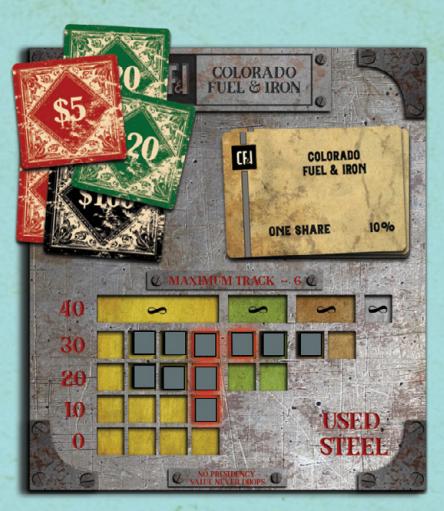
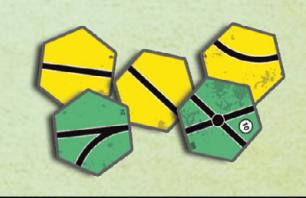
Using the steel market above, a company plans to buy the tiles shown below. This action will cost them $130: $60 for the three yellow steel tiles ($10 + $20 + $30) plus $70 for the green steel tiles ($30 + $40). This is only 5 tracks, so the player can still lay one more if they wish — that track, whether yellow or green, would cost $40, since both chosen columns now have no steel left.
Special Rules for Laying Track
Gold Mine Spaces
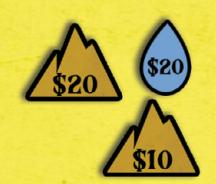
When laying a tile on a gold-mine space, place one gold cube from the supply onto the tile for each gold-mine symbol on that hex.

Royal Gorge Tiles
Royal Gorge tiles are placed only in the Royal Gorge space. Station spaces on the yellow tile are exclusively reserved for Rio Grande (indicated by the "X"). The green tile cannot be placed by any company — it is automatically placed during the Treaty of Boston event. The brown gorge tile may be placed by any company during their operating turn, as it may offer better revenue.
Terrain Costs
Some spaces require terrain costs. These are always paid by the company (to the bank) laying the track.
Letter Tiles
Some cities on the board require a special "letter tile" with a matching abbreviation. If a city has a letter abbreviation and a corresponding tile for the current phase, that tile must be used. If no matching tile is available, any legal tile can be placed. Some letter tiles offer multiple upgrade options — in these cases, the player decides which to use, potentially adding more station spaces. However, tiles cannot be upgraded in a way that reduces the number of station spaces, even if they are not currently in use.
2. Build a Station
Each train company has a limited number of stations. Placing stations opens new routes but — more importantly — blocks rivals from reaching revenue centers they need.
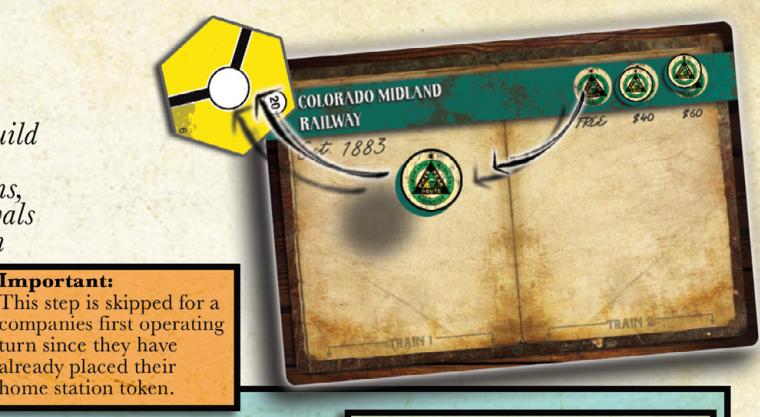
- Choose an empty station space that is connected to at least one other station of that company (via a valid, unblocked route — even if current trains can't physically reach it).
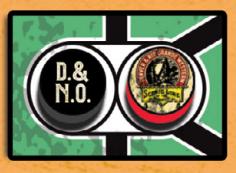
- Place the next station token from left to right on the charter. The "Free" home-station token must be placed on the company's first operating turn. Players may not skip tokens to use a cheaper one.
- Pay the token cost (printed below each token on the charter) from the company's treasury to the bank.
Home stations for companies that have yet to be started are reserved for that company and may not be used by others.
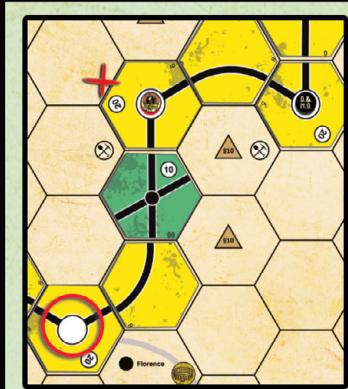
3. Run Trains
Running trains is the lifeblood of every railway company, fueling its growth and success. The income generated from these runs can be used to pay dividends to shareholders, acquire more trains, build new stations, settle debts, and purchase private assets. This is the core of the game — the true essence of 18xx. Each operating turn, the company's president must strategically expand, conquer new territories, and secure higher-paying revenue centers, driving the company toward dominance in the ever-evolving railway empire.
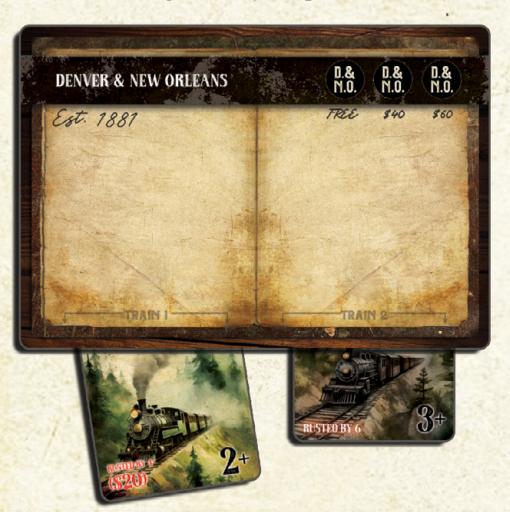
At the bottom of each company charter are two spaces to tuck your trains. A company can only have two trains under its charter at any time. Each train must run on completely unique tracks; however, trains may run to the same revenue center (city, town, or off-board) as long as they use different tracks to get there. The number in the lower-right of the train card indicates how many revenue centers that train can use. Some trains have slightly different rules (see below).
Train Types at a Glance
- Plus (+) trains: The "+" means "plus towns." These trains can use 2–5 cities or off-boards, plus as many towns as they can reach on the route (2+, 3+, 4+, 5+).
- 6×2 trains: Hit up to 6 total revenue centers (towns, cities, or off-boards), then double the total revenue.
3 Rules About Running Trains
Each of a company's trains must run on a route that contains at least two revenue centers. In addition:
The station doesn't have to start or end the route — it just has to be somewhere on it.
A single train may not enter the same city more than once. A different train of the same company may, as long as it uses different tracks.
Each train must run on completely unique routes and may not double back on any segment, no matter how small.
Train routes may not pass through fully occupied stations. If all station spaces in a city are occupied by other companies, you may not run through that city — but you may still run to it to collect revenue. And no sharp (hairpin) turns are allowed.



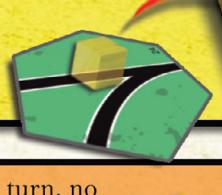
Shipping Gold
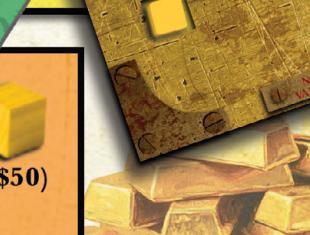
Each company may ship one gold cube per operating turn on a route they are running. Take the desired cube from the route and place it in the lowest-valued vacant space on the gold dividends track.
Only spaces matching the current phase are available. The red space can never be used — a maximum of 5 gold can be shipped during a set of operating rounds. As cubes cover spaces, Victor Gold Co. dividends increase up to a potential max of $350.
Only one gold cube per company can be shipped per operating turn, no matter how many trains they run. However, if there's still space on the gold shipment track in the next operating turn, they may ship another gold. This means each company is guaranteed the ability to ship one gold per set of operating rounds — but if they miss that opportunity, another company can ship gold again. Each gold you ship adds $50 to your revenue.
Calculating Revenue
For each train, add up the revenue numbers of every stop it makes. This is your total route revenue. If the company shipped a gold cube this turn, add $50.
4. Pay Dividends or Withhold Revenue
Once your company begins generating revenue, you, as the president, face a critical decision: what will you do with that money? Will you reward the shareholders who trusted you with their hard-earned dollars, believing your company to be a sound investment? Or will you hoard the cash to finance new trains, depriving everyone — including yourself — of the chance to profit?
This decision is pivotal and cannot be overstated. While withholding funds occasionally to prepare for upcoming expenses is prudent, doing so too often can backfire, stalling your stock's relentless march upward in the market. The path you choose will shape the future of your company and your fortune. Choose wisely.
Pay Dividends
Divide the total revenue by 10 and distribute it per share (from the bank):
- Shares held by players → that player's cash mat.
- Shares on the company charter → company treasury.
- Shares in the bank pool → skip (money goes back to the bank).
Stock price movement after paying dividends:
- Revenue less than share price → no change.
- Revenue ≥ share price → one step right.
- Revenue ≥ double share price → two steps right.
- Revenue ≥ triple share price → three steps right.
- No revenue paid (withheld, or company produced none) → one step left. (This always occurs in a company's first operating round.)
Withhold Revenue
If withholding, the full revenue goes to the company's treasury, and the stock price moves one space left.
Jim's company ran two trains, totaling $120 in revenue. Jim decides to pay dividends because he owns 6 shares and needs money for the upcoming stock round. From the bank, Jim gets $72. Derek owns one share, so he receives $12, and Tony, with 3 shares, gets $36 from the bank. Chad, with no shares, gets nothing.
5. Buy Trains
No train company can thrive without trains, and as time goes on, you'll need more of them. But beware — trains "rust" (become obsolete) as newer technology rolls in. Staying ahead of your rivals means planning your train purchases wisely. Your ultimate goal? Securing a "permanent" train that won't rust for the rest of the game. But timing is everything — choose carefully when and what to buy to outmaneuver your competition.
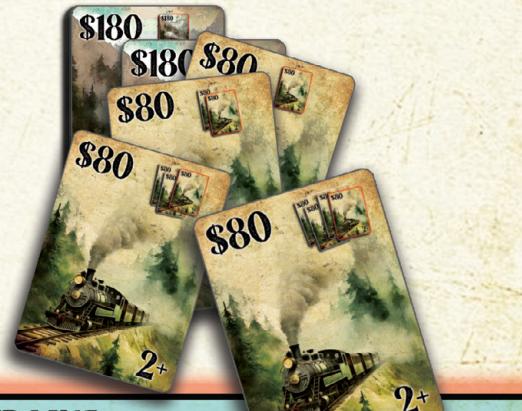
Buy from the Train Deck
Pay the price listed in the top-left corner of the train card from the company's treasury to the bank.
Buy from Another Company
If two companies' stations are connected by a valid route, the acting company can buy a train from the other if both presidents agree (often the same person). The price can be anywhere from $1 up to any amount the buying company can afford.
Important Rules About Trains
If the company can't afford a train, the president must cover the difference with personal funds. If still insufficient, the president must initiate Emergency Fundraising. Exception: If the company has no valid route, it doesn't have to own a train.
You may temporarily exceed the 2-train limit if the purchase causes one of the current trains to rust.
Once purchased, a train must remain with the company until it becomes obsolete or is bought by another company.
Emergency Fundraising
If a company can't afford a train, the president must contribute personal funds. If still insufficient, the president must sell shares until they can cover it.
- Any shares are eligible — not just those of the company raising funds.
- Shares cannot be sold if it would change company ownership.
- Shares cannot be sold if it would push the bank pool over 50% for any company.
- After the train is purchased, there will be no money left in the company's charter.
All normal rules for stock-price movement apply — including presidents dropping the share value of their own company on a sale.
Bankruptcy
If emergency fundraising still leaves insufficient funds, the player is bankrupt and the game immediately ends. All of the player's cash is contributed to the company. For scoring, that player only evaluates their remaining shares.
6. Pay Off Debt (Santa Fe and Rio Grande)
Once the Treaty of Boston event occurs, the debt marker will begin to rise each operating round, representing the accumulating interest on the debts each company owes. Companies must work to pay off this debt by the end of the game, or face severe consequences — such as plummeting share prices.
When to pay off these debts is entirely up to the president, but keep in mind that only one debt marker can be paid off per operating round, and time is not on your side. Be strategic — don't let the clock run out before your debts are settled!
Remember, the debt price token only moves once the Treaty of Boston event occurs. To help new players, consider placing this token slightly above the stock market track until the event occurs.
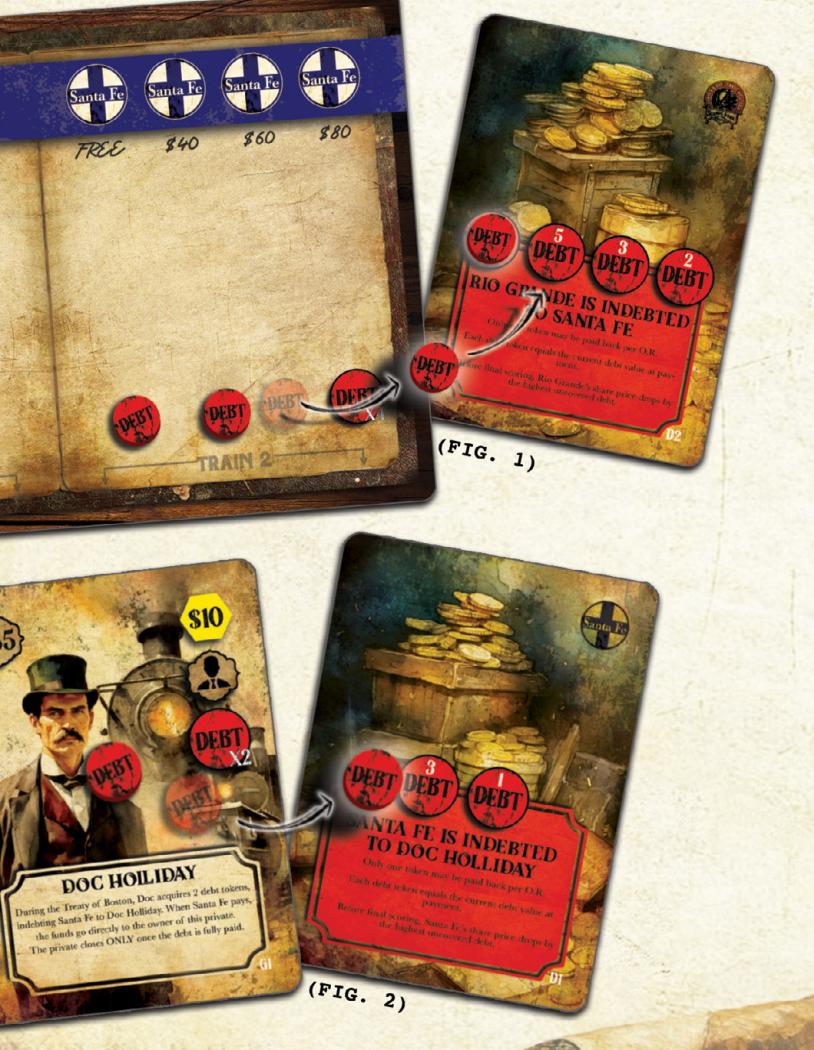
When the Treaty of Boston occurs, Santa Fe gains 4 "Debt" tokens on their charter. Rio Grande must buy these from Santa Fe, placing them left-to-right on the debt card. If not all debts are paid by game end, Rio's share price drops by the highest uncovered white number. Money paid goes on Santa Fe's charter.
Doc Holliday gains 2 "Debt" tokens. Santa Fe must buy these from Doc Holliday, placing them left-to-right. If not paid by game end, Santa Fe's share price drops by the highest uncovered white number. Money goes to the player who owns Doc Holliday; if Doc wasn't selected during setup, the money goes to the bank.
7. Buy Private Assets (Optional)
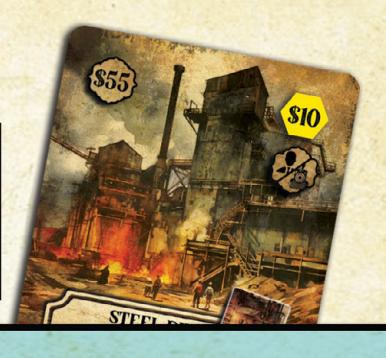
You can make this move anytime during a company's operating turn. Buying private assets into the company unlocks powerful abilities that can give your company a competitive edge. But that's not all — it also allows you, the savvy tycoon, to siphon capital from the company straight into your own pocket. This is a crucial, game-changing move. Strike while the iron is hot!
Once Green Phase is triggered, train companies may buy private assets from players for ½ to 2 times the private's face value (minimum bid price, not auction price).
A train company may offer to buy any player's private (usually their own). If the owner agrees, the train company pays the agreed amount from its treasury and takes the private into the company's treasury. The private then pays into the train company's treasury each operating round.
Only privates with the locomotive logo in the upper corner can be held by a company.
Once the game enters the Silver Phase, privates may no longer be purchased by companies.
End of Operating Round
After each company operates in descending share-price order, the operating round ends.
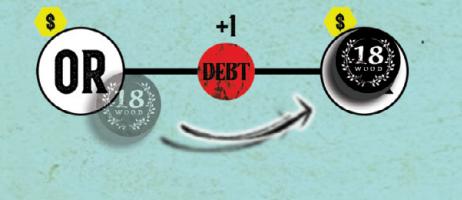
After the 1st Operating Round
Advance the round marker to the 2nd OR space. If the Treaty of Boston event has occurred, move the debt marker one space right.
After the 2nd Operating Round
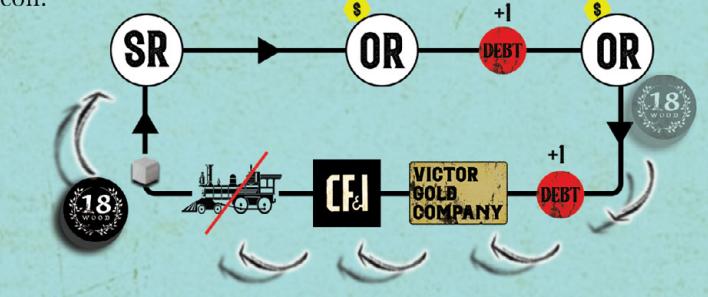
Advance the round marker back to the next stock round, performing each of these steps as the marker passes over the icons:
- If Treaty of Boston has occurred, move the debt marker one space right.
- Pay Victor Gold Company dividends — revenue equals the lowest uncovered space on the gold shipment track.
- Export a train: remove the next train from the train deck. If the deck is showing a 2+ train, export all 2+ trains.
- Pay CF&I dividends — add up all money in CF&I's dividends box, distribute, then return all but $50 to the bank.
- Refill the steel market as during setup — one cube in every empty space.
After the first set of operating rounds, any remaining 2+ trains are exported. This ensures the game always enters the green phase, allowing two more companies to be started.
Triggering the End of Game
The game has reached its final stop, and it's time to reveal who among you is the most ruthless and cunning railway tycoon.
3 Ways to End the Game
Ending 1: Bankruptcy
If any player goes bankrupt, the game immediately ends. Move directly to final scoring without completing the current operating round.
Ending 2: Stock Value Cap
If a company's stock marker reaches the red spaces of the stock market, finish the current set of operating rounds, then score. Applies even if game end was already triggered.
Ending 3: Silver Phase Is Reached
If a company buys a train that reveals the "Game End Triggered" event card, finish the current set of ORs, complete one more stock round, then one final set of ORs, and the game ends.
Calculating Scores
Each player receives money for the shares they possess at the end of the game. Multiply the final stock value of each share by the number of shares owned; collect that amount from the bank. Repeat for every company held. (Money is not limited, but scores often exceed the provided tokens — it is typically easier to use pen and paper to tally the scores.)
Add all share money to remaining cash. The player with the highest total is the winner. In the event of a tie, the tied players should shake hands and agree to a rematch.
Money and trains left on company charters do not count. These companies were merely a means to an end — your true success lies in the wealth you've personally accumulated.
Variants
Although the variability in 18RoyalGorge is already quite high from game to game, players who wish to change things up even more can introduce the following variants. Most of these can be combined with each other.
Auction Variant
Each time a player wants to start a new train company, they must auction off the rights to do so. The initiating player begins the bid at any $5 increment. In clockwise order, players may place higher bids in $5 increments. When all but one player has passed, the highest bidder pays their bid to the bank (this payment does not contribute to starting the company). The winning player then starts the company normally. If the auction winner is different from the initiator, play resumes with the initiating player.
The auction variant helps balance perceived (or real) differences between companies. We recommend using this variant for every game after your first.
2-Player Variant
Identical to the standard game, except that players may own up to 70% of any given company — including Victor Gold and CF&I.
Hand-Picked Variant
Private asset cards are one of the most enjoyable parts of the game, and sometimes it's fun to choose the ones you want to include. During setup, instead of selecting private asset cards at random, all asset cards are given to the player to the left of priority deal. That player selects one private to include and passes the remainder to the next player, and so on, until there are two yellow, two green, and one brown in play. If the first player picks a brown card, no other player may pick a brown card.
No Privates Variant
When introducing new players, remove private assets altogether for a simpler game.
Alternate Gold and Steel Prices
Before dealing out private asset cards, shuffle cards labeled Y1, Y2, Y3, G1, G2, and G3 together. Randomly choose a yellow card and set the steel price to its minimum bid price. Flip a green card and set the gold price to its minimum bid price. Then proceed with selecting private asset cards as usual.
Shorter Game
When the end game is triggered — regardless of condition — finish the current set of operating rounds and then score. If end game is triggered by a train export, still complete the stock round and its set of ORs. This variant limits the end game to at most one complete set of operating rounds.
Private Asset Reference
This reference summarises every private in the game. For full historical flavor text and diagrams, see the PDF rulebook.
Yellow Privates
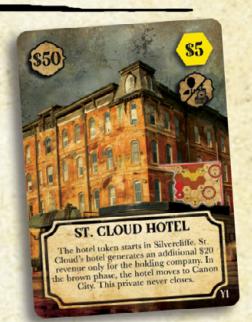
St. Cloud Hotel Y1
The St. Cloud Hotel began its journey in 1879 in Silver Cliff, Colorado, during the height of the silver boom. As the town's fortunes faded, so did the need for the grand hotel. But rather than face abandonment, the St. Cloud was dismantled and moved, piece by piece, to Cañon City in 1888. Reassembled in its new home, the hotel quickly became a beacon of luxury and a hub for travelers exploring the stunning Royal Gorge. Its remarkable relocation and rebirth in Cañon City reflect the resilience and ambition of the era, transforming it into a storied landmark with a rich history.
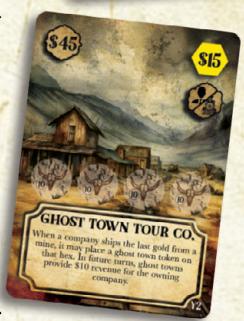
Ghost Town Tour Company Y2
The "Ghost Town Tour Co." may be a fictional private asset, but it's deeply rooted in Colorado's rich gold mining history. During the gold rush, countless towns sprang up overnight, thriving on the promise of fortune. However, as the gold veins ran dry, many of these bustling boomtowns quickly turned into ghost towns, abandoned and forgotten. The Ghost Town Tour Co. lets one player profit from this inevitable decline, capturing the eerie charm of these once-thriving communities that now echo with the whispers of Colorado's past. In fact, Colorado is home to nearly 1,500 ghost towns, each with its own story of boom and bust.
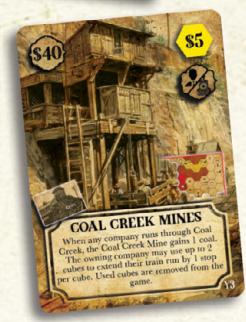
Coal Creek Mines Y3
In the 1870s, Coal Creek, Colorado, emerged as a bustling mining town during the height of the coal boom. Located near the rich coal fields of Fremont County, the town quickly grew as miners flocked to the area in search of work. Coal Creek was a typical frontier mining town, with its economy centered around the extraction of coal to fuel the expanding railroads and the growing industrial needs of the region. The town's development was closely tied to the nearby Denver & Rio Grande Railway, which transported coal from the mines to various parts of Colorado. Despite its initial prosperity, Coal Creek — like many mining towns of the era — faced the boom-and-bust cycle typical of the period, with its fortunes rising and falling with the demand for coal.
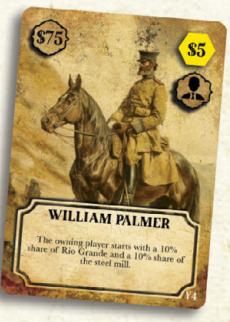
William Palmer Y4
William Jackson Palmer was a key figure in Colorado's 19th-century development. A Civil War hero and Union Army general, Palmer founded the Denver & Rio Grande Railway in 1870, envisioning a narrow-gauge railway to connect Colorado's rugged terrain. His railway was crucial in opening the Rockies to commerce and settlement. Palmer also co-founded Colorado Fuel and Iron (CF&I), which became a major industrial force, providing steel for railroads and fueling the state's industrial growth. His legacy includes the city of Colorado Springs, which he founded, and his lasting impact on Colorado's infrastructure and industry.
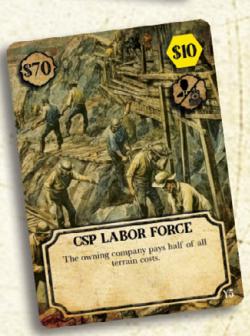
Colorado State Prison Labor Force Y5
In the late 1800s, inmates at the Colorado State Prison (now known as the Colorado Territorial Correctional Facility) were integral to the expansion of the region's infrastructure, including the construction of railroads. These prison work crews were tasked with some of the most grueling labor — laying tracks, building tunnels, and maintaining the railroads that connected Colorado's growing towns and cities.
The use of inmate labor was a pragmatic solution to both the prison's overcrowding and the state's need for a cheap, reliable workforce. Prisoners were sent out under heavy guard to remote and rugged areas where they helped carve out routes through the mountains and across the plains. Their work was crucial in enabling the rapid development of the rail network that would become a lifeline for Colorado's economy.
This practice not only provided the state with vital infrastructure at a fraction of the cost but also exemplified the harsh conditions inmates faced. The legacy of these work crews is still evident today in the railroads that traverse Colorado's rugged terrain, a testament to the labor of those who toiled under the watchful eyes of prison guards over a century ago.
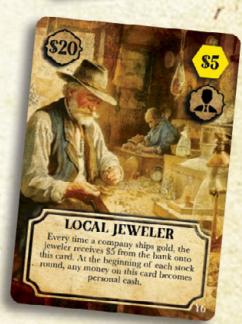
Local Jeweler Y6
The "Local Jeweler" may be a fictional private asset, but it's a nod to Colorado's vibrant history of gold mining and the art of fine jewelry crafting. During the gold rush, prospectors swarmed the Rocky Mountains, striking it rich in glittering veins of gold. As fortunes were made, skilled artisans transformed these precious finds into exquisite jewelry, symbolizing the wealth and prosperity of the era. The Local Jeweler captures this legacy, representing the journey of Colorado's gold from raw nuggets pulled from the earth to the beautifully crafted pieces that adorned the pioneers and high society of the Old West.
Green Privates
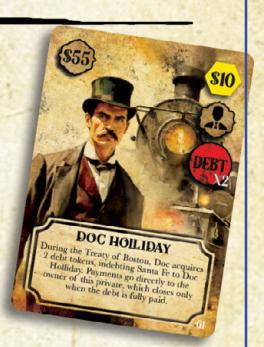
Doc Holliday G1
Doc Holliday — the infamous gunslinger and gambler — was a key figure in the Old West, known for his deadly skills and close friendship with Wyatt Earp. During the Royal Gorge War in the late 1870s, a fierce battle erupted between the Atchison, Topeka, and Santa Fe Railway and the Denver and Rio Grande Railroad over control of the lucrative rail route through the Royal Gorge. This conflict, though largely a legal and financial struggle, had its rough edges, with armed men hired by both sides to assert control.
Holliday, with his reputation as a deadly shot, was recruited by the Santa Fe Railway to provide some muscle. Though Holliday's involvement in the Royal Gorge War was brief, it added to his legendary status as a man who was feared and respected in equal measure. Eventually, the war ended with a legal settlement, but Holliday's role in the skirmish remains a fascinating footnote in the history of the American West.
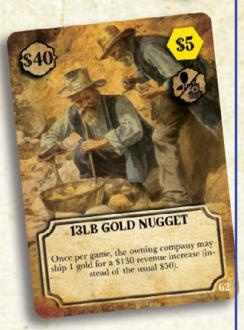
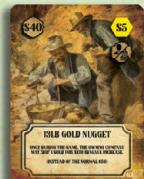
13lb Gold Nugget G2
In the late 1800s, during Colorado's Gold Rush, a massive 13.5-pound gold nugget was discovered in the rugged hills, becoming one of the largest ever found in the state. Known as "Tom's Baby" after its discoverer, Tom Groves — who carried it like a child from the mountains — this nugget symbolized the untamed wealth that drew thousands to the Rockies, embodying the era's spirit of fortune-seeking and adventure.
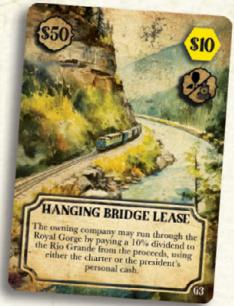
Hanging Bridge Lease G3
The Hanging Bridge in Royal Gorge, built in 1879, is a stunning feat of engineering. Suspended on girders anchored to towering granite cliffs, it was designed to allow trains to pass through the gorge's narrowest point — where traditional rail beds were impossible. This bridge was vital in connecting Denver to Colorado's mining towns, driving the state's economic boom. Today it still serves the Royal Gorge Route Railroad, offering passengers dramatic views and a glimpse into the ingenuity of the past.
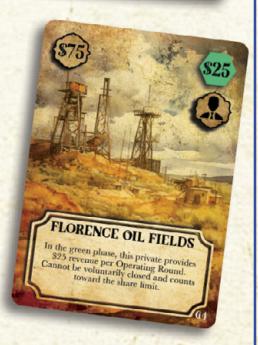
Florence Oil Fields G4
The Florence oil fields in Colorado are historically significant as the location of the first commercial oil well west of the Mississippi, drilled in 1881. This discovery marked the beginning of the state's oil industry, leading to rapid development in Florence. By the 1890s the town was home to several refineries, including the United Oil Company, which refined Florence's high-quality crude. At its peak, the Florence oil fields produced millions of barrels of oil annually, and the town flourished with the influx of workers and businesses.
Kayla Ross and Denman Scofield, both of whom grew up in Florence, were deeply inspired by this rich history.
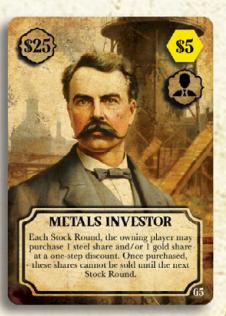
Metals Investor G5
Colorado Fuel and Iron (CF&I), now known as "Pueblo Steel," was a cornerstone of Colorado's industrial boom, founded in 1880. As the first integrated steel mill west of the Mississippi, CF&I played a pivotal role in the development of the railroads that connected Colorado to the rest of the country. The steel rails produced in Pueblo laid the tracks for Colorado's expanding railroad network, crucial in linking the state's mining towns and agricultural areas with national markets. CF&I's influence extended beyond steel production, as the company also controlled vast coal and iron ore resources, feeding the demand for rail expansion. The Metals Investor private asset is designed to embody the rich financial legacy of steel that emerged from southern Colorado.
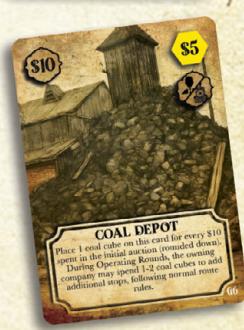
Coal Depot G6
Fremont County, Colorado is steeped in the rich history of coal mining, a legacy that dates back to the late 19th century. As railroads began to carve their way through the rugged terrain, the demand for coal surged, and Fremont County quickly became a vital hub for the industry. Towns like Florence and Coal Creek thrived, with mines dotting the landscape, fueling the locomotives that powered the expansion of the American West. The coal extracted from these mines not only drove local economies but also played a crucial role in Colorado's broader industrial growth, particularly in supporting the booming steel industry in nearby Pueblo. Today, the remnants of these once-bustling mines serve as a reminder of the hard work and resilience that built the region.
Brown Privates
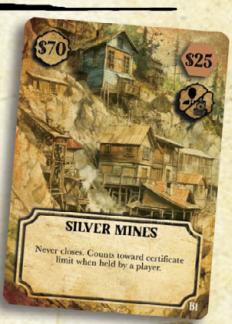
Silver Mines B1
Fremont County, Colorado played a key role in the late-19th-century Colorado Silver Boom. Towns like Silver Cliff and Rosita emerged as bustling mining communities, fueled by the discovery of rich silver veins. Although the boom was short-lived — as silver prices fell and mines were exhausted — these silver mines contributed significantly to the early economic growth of the region. Today, remnants of these mining operations serve as historical reminders of the county's silver-rich past.
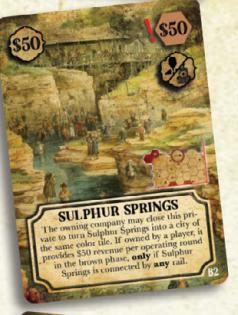
Sulphur Springs B2
Sulphur Springs, Colorado is steeped in history, with its hot springs long revered for their healing properties. Indigenous peoples, including the Ute tribe, were among the first to discover and use the mineral-rich waters, believing them to be sacred and medicinal. When European settlers arrived in the 19th century, they quickly recognized the springs' value, leading to the establishment of a bustling resort town. Visitors flocked to the springs, seeking relief from ailments and the restorative powers of the natural baths. Sulphur Springs' hot springs remain a cherished destination, echoing the past while continuing to offer the timeless allure of healing and relaxation.
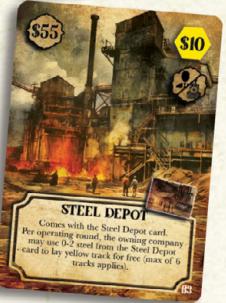
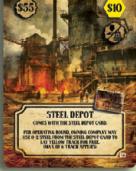
Steel Depot B3
Colorado Fuel and Iron (CF&I) had a profound impact on Colorado's railroading history. As the state's largest steel producer, CF&I supplied the essential steel rails that connected Colorado's mining towns and agricultural regions to national markets. The company's steel mill in Pueblo was integral to the expansion of the rail network, driving the economic growth of the state and facilitating the rapid development of the American West. CF&I's contributions helped shape Colorado's infrastructure, making it a key player in the region's transportation and industrial history.
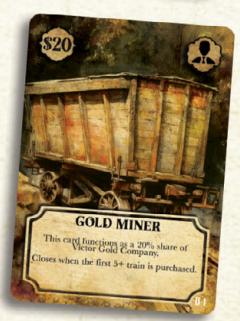
Gold Miner B4
Gold miners in Colorado — especially during the late 19th and early 20th centuries — often earned low wages despite extracting valuable gold. To supplement their income, some miners engaged in "high-grading," the illegal practice of stealing small bits of gold ore from the mines. In towns like Victor and Cripple Creek, miners would smuggle out pieces of high-grade ore hidden in their clothing or lunch pails. Despite the risks (including searches and surveillance by mine owners), high-grading persisted as a way for miners to make extra money, reflecting their frustration with low pay and the harsh conditions they endured. This practice also contributed to the broader labor tensions in Colorado's mining industry.
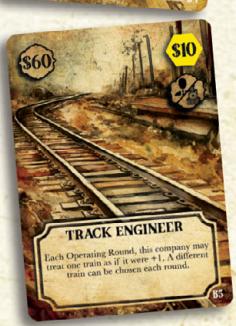
Track Engineer B5
In the 1800s, "Track Engineers" were vital to the expansion and efficiency of the railroads. They were responsible for designing, constructing, and maintaining railroad tracks — ensuring they were properly aligned, graded, and supported. Their work involved surveying land, designing track layouts, and overseeing the construction of bridges and tunnels. Track engineers also conducted regular inspections and repairs, ensuring tracks were level and secure, which helped prevent accidents and allowed trains to run faster and carry heavier loads. Their expertise enabled trains to travel longer distances efficiently, playing a key role in the successful expansion of railroads across the United States.
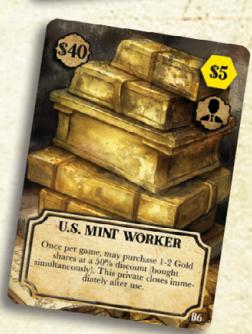
US Mint Worker B6
The U.S. Mint in Denver, Colorado has a rich history intertwined with the state's mining and railroad industries. Established in 1906, the Denver Mint was built in response to the immense wealth of precious metals — particularly gold and silver — extracted from Colorado's mountains during the late 19th century. The railroads played a crucial role: trains would carry raw ore and bullion directly to Denver, where it was processed and transformed into coins. The proximity of the Denver Mint to the railroads was no accident — the efficient movement of gold and silver via rail was essential to the Mint's operations.
Working as a mint worker in the late 1800s would have been a demanding yet prestigious job. Workers were responsible for handling vast quantities of precious metals, weighing, melting, and striking coins with precision. Security was paramount; the Mint was heavily guarded, and employees were under constant scrutiny to prevent theft.
Expanded Content
Alternate Gold Shipment Tracks
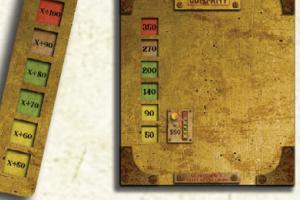
These alternate gold-mine tiles were (mostly) previous iterations of the gold market used during the game's development. Some new iterations are also included. While the board's design is balanced to our liking, that doesn't mean these alternate tiles are inferior by any means.
Setup: During setup, shuffle all 8 tiles and choose one at random; overlay this tile on the board so that it covers the original gold shipment track.
Additional rules:
- Certain tiles contain no yellow shipment spaces and cannot be shipped to until the green phase is triggered. This is indicated to players by a symbol on the tile.
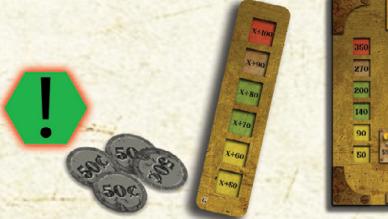
- Tile G pays out based on the current stock value of gold (X) plus an additional amount. For example, if the tile payout is "X + 70" and the current value of gold is $55, the dividend will be $125 (55 + 70), or $12.50 per share. Since using this tile may result in half-dollar payouts, several half-dollar tokens have been provided.
Alternate Doc Holliday (G1A, G1B)
Play as Doc, Annie Oakley, or the fictional "Mrs. Holliday."
Setup: If Doc Holliday is selected to be in the game during setup, the player who wins Doc Holliday can choose which version to play. All other rules remain the same.

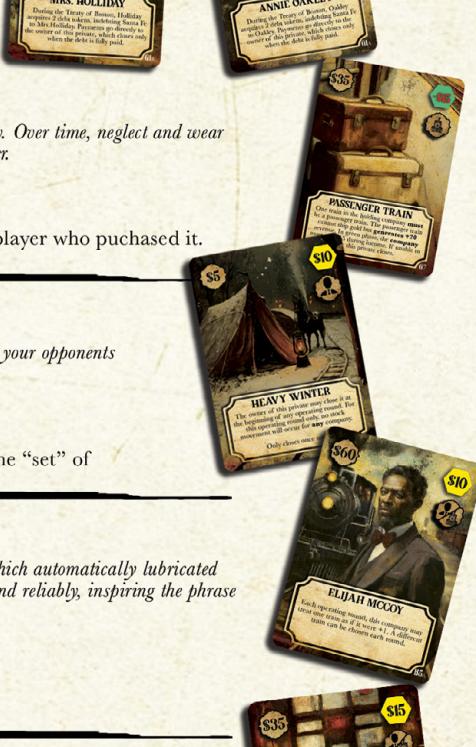
Passenger Train (private asset)
Passenger trains played a crucial role in Colorado's rich railroading history, connecting towns and fueling economic growth. In this game, your passenger train can generate steady income but comes at a cost to your company. Over time, neglect and wear may force you to retire the line altogether, reflecting the challenges of maintaining these lifelines on the rugged frontier.
Heavy Winter (B7)
Winters in Colorado are notoriously harsh, with icy winds and relentless snow. Time your moves carefully to freeze your opponents in their tracks when it matters most.
Elijah McCoy (B5A)
Elijah McCoy, a pioneering Black inventor, revolutionized the railroad industry with his innovative oil-drip cup, which automatically lubricated locomotive engines — eliminating frequent stops for maintenance. His genius invention kept trains running smoothly and reliably, inspiring the phrase "the real McCoy" as a mark of genuine excellence.
Buckhorn Exchange Steakhouse (Y7)
The Buckhorn Exchange, Denver's oldest steakhouse, is a living legend of the Old West — serving up frontier spirit with its iconic game meats and rich history. Founded in 1893, this National Historic Landmark boasts walls adorned with taxidermy and tales of gold rush prospectors, presidents, and cowboys who dined beneath its rustic charm.
Madam Evens (Y8)
Madam Laura Evens was a savvy and determined entrepreneur who rose to prominence as the operator of one of Colorado's most successful brothels. In an era where few women wielded influence, she built a thriving business that catered to miners, travelers, and townsfolk alike. Despite the societal stigma surrounding her profession, Laura amassed significant wealth and respect, becoming a symbol of resilience and independence in the heart of the Rockies. Her legacy endures as a testament to ambition and survival on the rugged frontier.
Alternate Gorge Tiles
Take the power away from Rio Grande with this variant. Some players don't like how powerful Rio Grande is, and this variant offers a weaker version of the company. Can you make it sing still?
Setup: During setup, players can decide which set to use — either the original tiles or the "B" side, which makes Rio less powerful.
Historical Notes
The Royal Gorge War was a dramatic and intense conflict that played out in the rugged and spectacular Royal Gorge of Colorado during the late 1870s. This deep, narrow canyon — carved by the Arkansas River — features towering granite cliffs rising over 1,000 feet on either side. The Gorge was not only a natural wonder but also a critical passageway, offering the most direct route to the booming silver mines of Leadville, one of the richest mining districts in the West. This made it a highly coveted prize for two of the most powerful railroads of the time: the Denver & Rio Grande Railway (D&RG) and the Atchison, Topeka, and Santa Fe Railway (Santa Fe).
The conflict began in earnest in 1878. Both railroads engaged in a series of legal maneuvers; when the courts failed to provide a swift resolution, the conflict spilled into physical confrontations. Armed guards — sometimes notorious gunslingers — were hired by both sides to protect construction crews and sabotage the rival's efforts.
Among the most famous of these gunslingers was Doc Holliday, hired by the Santa Fe to provide some muscle. His presence, along with other hired guns, brought a volatile mix of bravado and violence to the Royal Gorge, making the conflict as much about Old-West showdowns as legal disputes.
The dispute was ultimately settled not by force but in Boston, Massachusetts in 1880 via the Treaty of Boston. The agreement awarded control of the Royal Gorge to the Denver & Rio Grande Railway, allowing them to complete their line to Leadville. Santa Fe was compensated and redirected elsewhere.
This game is a heartfelt tribute to our upbringing in Fremont County, where the echoes of history are deeply woven into the landscape. We hope that as you play, you'll feel the theme resonating with every decision you make and every mile of track you lay. Our greatest wish is that it leaves you with a deeper appreciation for the history and the stories that inspired its creation.
Credits
Thank you to Dave Berry for his valuable recommendations on the rules. His feedback greatly improved this rulebook. Thanks, Dave!
Playtesters
Scott Petersen, Phil Chen, Michael Wang, Brandon Stover, Derek McCabe, Jim Miller, Jen McConnell, Tony Fryer, Brandon Bashein, Greg Holton, Michael Brandt, Jon Cox, Chad Jacobson, Wayne Williams, Oleg Savelyev.
And thank you to all the 18xx designers that have come before us. This game is not only the result of our design skill, but of every designer who has come before us: Francis, Lonny, Ohley, Wolfram, Dixon, TraXX, Hecht, Hutton, Lawson, Derrick, Lehman, and many more — thank you!
18RoyalGorge was developed using 18xx-maker.com. The 18xx game system was originally created by Francis Tresham.